
French pronouns are words that replace a noun or noun phrase to avoid repetition and make sentences smoother. They can refer to people, animals, objects, places, or ideas. French has several types of pronouns, each with a specific grammatical function.
What Is a Pronoun?
A pronoun replaces a noun that has already been mentioned.
Example
Without a pronoun
Marie lit un livre. Marie aime ce livre.
Marie is reading a book. Marie likes this book.
With a pronoun
Marie lit un livre. Elle l’aime.
Marie is reading a book. She likes it.
Here:
- Elle replaces Marie
- l’ replaces le livre
Types of French Pronouns
French pronouns are divided into several categories:
- Personal Pronouns
- Reflexive Pronouns
- Relative Pronouns
- Adverbial Pronouns
- Demonstrative Pronouns
- Possessive Pronouns
- Interrogative Pronouns
- Indefinite Pronouns
1. Personal Pronouns (Les Pronoms Personnels)
Personal pronouns replace the subject or object of a sentence.
Subject Pronouns
| French | English |
|---|---|
| je | I |
| tu | you (singular) |
| il | he |
| elle | she |
| on | one / we (informal) |
| nous | we |
| vous | you (formal or plural) |
| ils | they (masculine or mixed) |
| elles | they (feminine) |
Examples
Je parle français.
I speak French.
Nous habitons à Lyon.
We live in Lyon.
Ils jouent au football.
They are playing football.
Direct Object Pronouns (COD)
These replace the direct object.
| Pronoun | English |
| me / m’ | me |
| te / t’ | you |
| le / l’ | him, it |
| la / l’ | her, it |
| nous | us |
| vous | you |
| les | them |
Examples
Je regarde le film. → Je le regarde.
I am watching the movie. → I am watching it.
Elle aime Marie. → Elle l’aime.
She loves Marie. → She loves her.
Indirect Object Pronouns (COI)
These replace nouns introduced by à.
| Pronoun | English |
| me | to me |
| te | to you |
| lui | to him / her |
| nous | to us |
| vous | to you |
| leur | to them |
Examples
Je parle à Paul. → Je lui parle.
I am talking to Paul. → I am talking to him.
Nous écrivons à nos amis. → Nous leur écrivons.
We write to our friends. → We write to them.
2. Reflexive Pronouns (Les Pronoms Réfléchis)
Reflexive pronouns are used with reflexive verbs and refer back to the subject.
| Subject | Pronoun |
| Je | me |
| Tu | te |
| Il / Elle / On | se |
| Nous | nous |
| Vous | vous |
| Ils / Elles | se |
Examples
Je me lève à sept heures.
I get up at seven o’clock.
Ils se couchent tôt.
They go to bed early.
3. Relative Pronouns (Les Pronoms Relatifs)
Relative pronouns join two clauses and avoid repeating a noun.
| Pronoun | Meaning |
| qui | who, which |
| que (qu’) | that, which |
| dont | whose, of which |
| où | where, when |
Examples
Le garçon qui parle est mon frère.
The boy who is speaking is my brother.
Le livre que j’ai acheté est intéressant.
The book that I bought is interesting.
La ville où je suis né est belle.
The city where I was born is beautiful.
4. Adverbial Pronouns
French has two important adverbial pronouns.
Y
Y usually replaces a place or something introduced by à.
Examples
Tu vas à Paris ? — Oui, j’y vais.
Are you going to Paris? — Yes, I’m going there.
Je pense à mes vacances. → J’y pense.
I’m thinking about my vacation. → I’m thinking about it.
En
En replaces nouns introduced by de or expresses quantity.
Examples
Tu veux du café ? — Oui, j’en veux.
Do you want some coffee? — Yes, I want some.
Elle parle de son travail. → Elle en parle.
She talks about her job. → She talks about it.
5. Demonstrative Pronouns
These replace a noun already mentioned.
| Pronoun | Meaning |
| celui | that one (masculine) |
| celle | that one (feminine) |
| ceux | those (masculine) |
| celles | those (feminine) |
Examples
J’aime cette robe, mais je préfère celle-ci.
I like this dress, but I prefer this one.
Ces livres sont intéressants. Ceux de Paul sont excellents.
These books are interesting. Paul’s ones are excellent.
6. Possessive Pronouns
Possessive pronouns show ownership without repeating the noun.
| Pronoun | English |
| le mien | mine |
| le tien | yours |
| le sien | his / hers |
| le nôtre | ours |
| le vôtre | yours |
| le leur | theirs |
Examples
Ce stylo est le mien.
This pen is mine.
Cette maison est la nôtre.
This house is ours.
7. Interrogative Pronouns
These are used to ask questions.
| Pronoun | Meaning |
| qui | who |
| que / qu’ | what |
| quoi | what |
Examples
Qui est là ?
Who is there?
Que fais-tu ?
What are you doing?
À quoi penses-tu ?
What are you thinking about?
8. Indefinite Pronouns
Indefinite pronouns refer to people or things in a general or non-specific way.
| Pronoun | English |
| quelqu’un | someone |
| personne | nobody |
| quelque chose | something |
| rien | nothing |
| tout | everything |
| chacun | each one |
Examples
Quelqu’un frappe à la porte.
Someone is knocking at the door.
Je ne vois personne.
I don’t see anyone.
Tout est prêt.
Everything is ready.
Common Mistakes
❌ Je parle il.
✔ Je lui parle.
❌ Je regarde Marie. Je regarde Marie tous les jours.
✔ Je la regarde tous les jours.
❌ Je vais à Paris. Je vais à Paris demain.
✔ J’y vais demain.
Practice Examples
Replace the noun with the correct pronoun.
- Je regarde le film. → Je le regarde.
- Elle téléphone à Sophie. → Elle lui téléphone.
- Nous allons à l’école. → Nous y allons.
- Tu veux du pain ? → Oui, j’en veux.
- Ce livre est mon livre. → Ce livre est le mien.
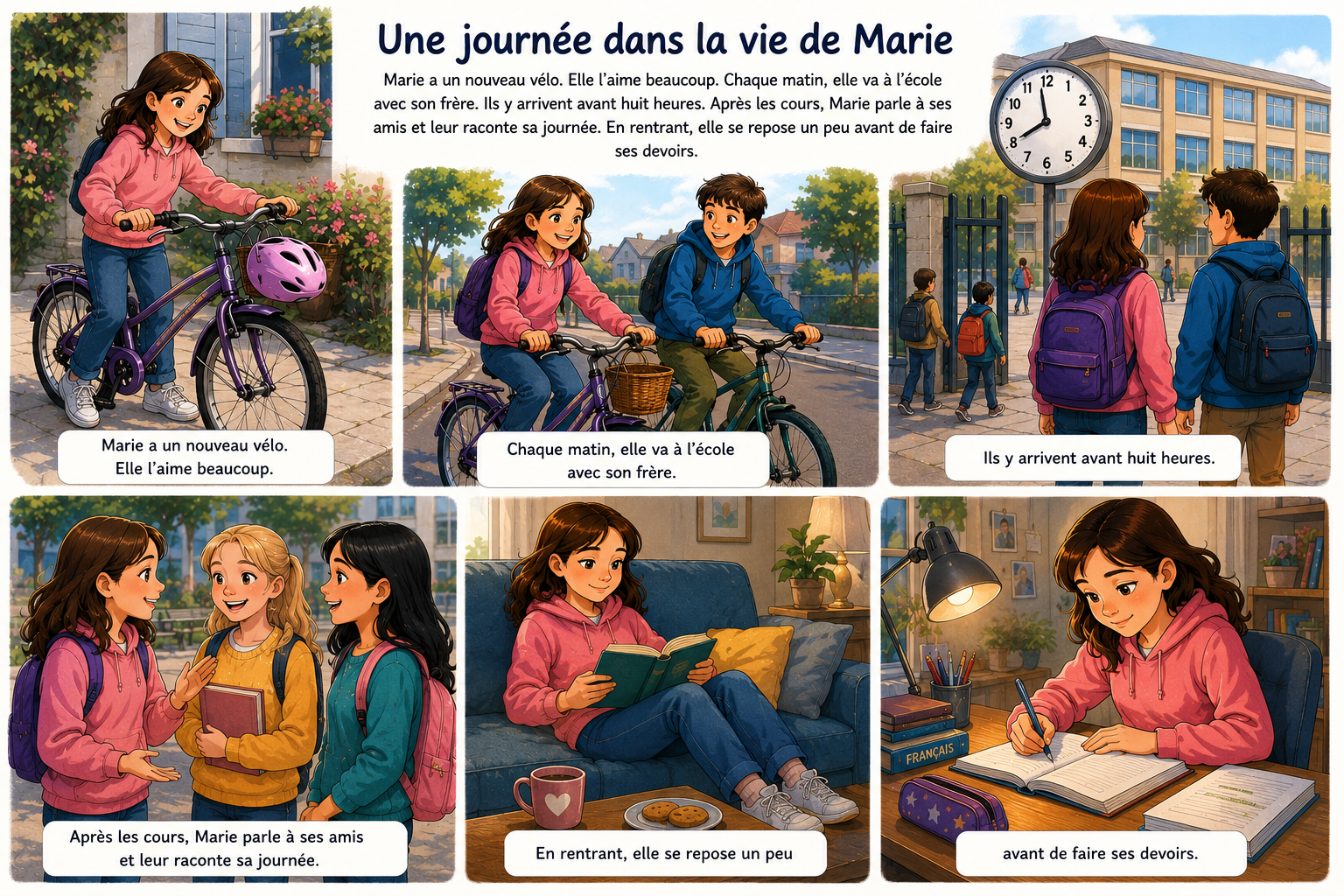
Story Example
French
Marie a un nouveau vélo. Elle l’aime beaucoup. Chaque matin, elle va à l’école avec son frère. Ils y arrivent avant huit heures. Après les cours, Marie parle à ses amis et leur raconte sa journée. En rentrant, elle se repose un peu avant de faire ses devoirs.
English
Marie has a new bicycle. She likes it very much. Every morning, she goes to school with her brother. They arrive there before eight o’clock. After class, Marie talks to her friends and tells them about her day. When she gets home, she rests for a while before doing her homework.